Fast Degrees, Slow Regret: The Illusion of “Affordable” Monthly Payments in Loan Colleges
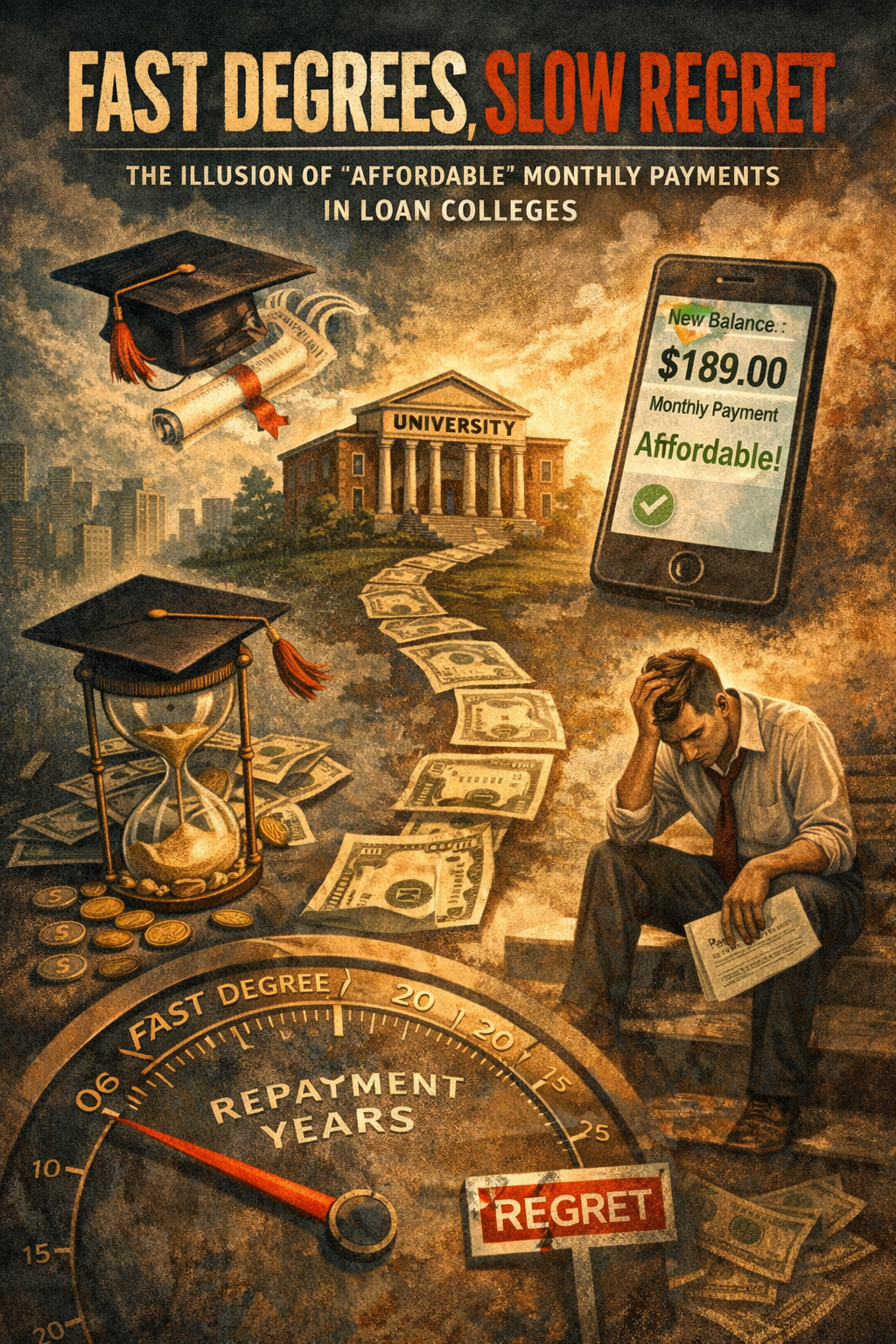
The number is designed to feel harmless.
“Only $189 a month.”
“Less than your phone bill.”
“Easily manageable after graduation.”
In loan colleges, affordability is rarely presented as a total cost. It is broken into pieces—small enough to swallow, familiar enough to trust. The price of a degree is not denied; it is simply deferred, diluted, and disguised.
Speed as the Selling Point
Fast degrees promise urgency in a world that feels stuck.
Finish in 18 months. Graduate faster. Get back to work sooner. The compressed timeline is framed as efficiency, not compromise. Students are told they are saving time, saving money, saving themselves from falling behind.
What often goes unsaid is that speed benefits the institution more than the student. Shorter programs mean quicker turnover, faster tuition capture, and reduced long-term responsibility for outcomes.
Speed sells. Reflection slows enrollment.
The Monthly Payment Trap
Loan colleges rarely lead with total debt. They lead with monthly comfort.
By focusing on small, recurring payments, the financial conversation shifts from magnitude to manageability. Long repayment terms—15, 20, even 25 years—quietly stretch the burden into the future, where it feels less real.
Students are encouraged to think like subscribers, not borrowers.
What disappears is the question that matters most:
How much will this degree actually cost me over time?
Affordability Without Context
“Affordable” is a powerful word—especially for students juggling rent, family obligations, and unstable income.
But affordability without income certainty is a gamble. Many graduates enter job markets that do not align with the optimistic salary projections shown during enrollment. Entry-level wages collide with fixed payments, and the math no longer works.
What was “manageable” on paper becomes suffocating in practice.
When Regret Arrives Late
Regret does not show up during orientation. It arrives quietly, years later.
It appears when:
-
raises are smaller than expected
-
promotions are delayed
-
life plans are postponed
-
loan balances barely move
Students realize that while the degree was fast, the consequences are slow—and stubbornly permanent.
The illusion was not that payments were affordable. It was that they would stay affordable.
The Psychological Design
This model thrives on behavioral economics.
People underestimate long-term costs. They prioritize immediate relief. They trust institutions that speak confidently about the future. Loan colleges know this—and structure their messaging accordingly.
The debt is not hidden. It is reframed.
By the time the full picture comes into focus, exit options are limited.
Who Benefits From the Illusion
Institutions are paid in full.
Lenders are protected.
Students shoulder the mismatch between promise and reality.
The affordability narrative transfers risk downward, while preserving the appearance of choice. Students technically agree to the terms—but rarely with the clarity that true consent requires.
A Degree Measured in Time, Not Value
Fast degrees assume that education is a race. That faster is better. That outcomes are guaranteed.
But education does not operate on a stopwatch. Skills take time. Networks take time. Careers take time. Debt, unfortunately, does not wait.
When the promise of speed meets the reality of repayment, regret fills the gap.
Beyond the Monthly Number
The real cost of loan colleges is not found in the monthly payment.
It is found in delayed freedom. In narrowed choices. In the quiet realization that affordability was defined only in the moment of signing—not across the decades that followed.
Fast degrees move quickly.
Regret takes its time.
And by the time it fully arrives, the balance is still there—patient, accumulating, and unforgiving.